Should You Hire a Direct Mail Company or Do It Yourself?
A practical guide to deciding which direct mail tasks your team should keep, which ones to outsource, and when one company should coordinate the campaign from audience to mailbox.
Printing and Mailing
Campaign Strategy
Small Business Marketing
Quick Answer
Hiring a direct mail company makes sense when your campaign requires more coordination than your team can manage confidently.
A small and simple mailing may be easy to handle yourself. Once audience data, design, printing, personalization, postal preparation, mailing, and tracking are split across several people or vendors, one experienced partner can make the process easier to control.
The Direct Mail Ownership Test
Write down who owns every stage of the campaign. Any blank space is a warning. Any task with two different owners may become a handoff problem.
Clear ownership matters more than mailing quantity alone.
Direct mail can look simple from the outside. Choose a postcard, print it, and send it.
In practice, a professional mailing is a chain of connected decisions. The audience affects the message. The message affects the mail piece. The mail piece affects production and postal preparation. The response method affects what can be measured later.
This does not mean every business needs a full service direct mail company. Some campaigns are completely manageable in house. The right decision depends on your team, your data, your format, your schedule, and how many handoffs you are prepared to manage.
1st Class Marketing can help you compare postcards, personalized letters, self mailers, EDDM, targeting, and tracking options before you request final pricing.
What Does a Full Service Direct Mail Company Actually Do?
A full service direct mail company manages or coordinates several stages of a mailing campaign. The exact scope depends on the provider and the project.
That work may include:
- Defining the campaign goal and offer
- Selecting or preparing the audience
- Cleaning and organizing mailing data
- Designing the postcard, letter, or self mailer
- Setting up personalization or variable information
- Printing and finishing the mail piece
- Processing addresses and preparing postal documentation
- Sorting and delivering the mailing to USPS
- Connecting the piece to QR codes, landing pages, phone tracking, or offer codes
- Reviewing results so the next campaign can improve
At 1st Class Marketing, direct mail and EDDM services can be coordinated with audience selection, data hygiene, design, printing, mailing, QR tracking, and campaign reporting.
The important question is not whether a provider calls itself full service. The important question is which tasks it handles, which tasks remain with your team, and who is accountable for each handoff.
A Direct Mail Campaign Is More Than Printing
A useful campaign connects the business goal to a measurable response. Printing is an important stage, but it sits in the middle of the process.
1. Define the Goal
Decide what the recipient should do next. Call, scan a QR code, visit a landing page, use an offer, request a quote, or book an appointment.
2. Choose the Audience
Use an existing customer list, build a targeted prospect list, or select postal routes for Every Door Direct Mail.
3. Select the Mail Piece
Match the format to the message. A postcard, personalized letter, folded self mailer, or EDDM piece serves a different purpose.
4. Design and Produce It
Plan the size, paper, folds, bleeds, coatings, personalization, address area, and proofing before the full print run begins.
5. Prepare the Mailing
Process the addresses, sort the records, prepare the required documentation, and coordinate entry with USPS.
6. Build the Response Path
Connect the mail piece to a phone number, offer code, landing page, custom URL, or dynamic QR code.
7. Measure and Improve
Compare responses with the audience, offer, format, timing, and call to action. Save the final specifications for the next campaign.
A strong campaign does not treat these as unrelated jobs. Each stage should support the next one.
DIY, Hybrid, or Full Service: Which Model Fits?
There is no single correct setup. The best choice is the one that gives every task a capable owner and keeps the handoffs easy to manage.
DIY
Your team manages the list, creative, printing, postal work, mailing, and tracking.
Hybrid
Your team keeps strategy or creative control while specialists handle selected production, data, or mailing tasks.
Full Service
One partner coordinates several or all stages through a single campaign workflow.
When DIY Direct Mail Makes Sense
- The mailing is small, simple, and occasional.
- Your list is already accurate and properly formatted.
- Your artwork is complete and ready for production.
- Your team understands the postal requirements.
- You have enough staff time to manage printing, assembly, documentation, and delivery.
- You already have a reliable way to track the response.
When a Hybrid Setup Makes Sense
- Your team wants to keep control of the offer, copy, or brand direction.
- You need a specialist to clean the data or build the audience.
- A printer or mail provider will handle production and postal preparation.
- Your team and the provider have clearly divided the tracking and reporting work.
When Full Service Starts Making Sense
- You need audience targeting, design, printing, and mailing.
- The piece uses personalization or variable data.
- Your team is coordinating several vendors and repeated handoffs.
- Postal preparation is consuming too much staff time.
- You plan to mail at meaningful volume or repeat the campaign.
- You want one team accountable for keeping the project moving.
Who Owns Each Direct Mail Campaign Task?
This comparison is more useful than asking which option is always best. Look at who owns each task under the setup you are considering.
Audience and Data
DIY: Your team selects and prepares the list.
Hybrid: Your team supplies the data and a specialist cleans or enhances it.
Full service: The provider helps select, build, or prepare the audience.
Creative and Format
DIY: Your internal team supplies final production files.
Hybrid: Your team supplies the concept and an outside partner prepares it for production.
Full service: Design and production requirements are coordinated together.
Printing and Finishing
DIY: Your team buys materials or manages a separate printer.
Hybrid: A printer handles the defined production work.
Full service: Printing and finishing are included in the campaign workflow.
Postal Preparation
DIY: Your team owns address processing, documentation, sorting, and delivery.
Hybrid: A mail provider handles selected postal tasks.
Full service: Postal preparation is coordinated with the data, design, and production.
Tracking
DIY: Your team builds and monitors the response path.
Hybrid: Tracking tools and reporting are shared.
Full service: Tracking can be planned as part of the campaign before printing.
Accountability
DIY: Your internal team owns every handoff.
Hybrid: Responsibility is divided across your team and outside specialists.
Full service: Fewer handoffs can create a clearer campaign owner.
Already Have a List or Campaign Idea?
Send the basics. We can help identify which parts are ready, which parts still need work, and whether a DIY, hybrid, or full service approach makes the most sense.
Use the Direct Mail Ownership Test
Before choosing a provider, place one name next to every important campaign responsibility.
- Who approves the audience and mailing list?
- Who checks duplicate, outdated, or incomplete records?
- Who approves the offer and call to action?
- Who confirms the final size, paper, folds, and production specifications?
- Who tests names, addresses, and other variable information?
- Who reviews and approves the final proof?
- Who prepares the mailing data and postal documentation?
- Who coordinates the print schedule and USPS entry?
- Who tests the QR code, phone number, landing page, or offer code?
- Who reviews results and keeps the final campaign records?
If every line has one clear and capable owner, your current setup may work well. If several lines are blank, duplicated, or spread across unrelated vendors, a coordinated direct mail company may reduce the weak points.
The goal is not to outsource for the sake of outsourcing. The goal is to remove unclear handoffs while keeping the decisions that belong inside your business.
Printer, Mail House, Agency, or Direct Mail Company?
Businesses often use these labels as though they mean the same thing. They do not. Ask about actual responsibilities instead of relying only on the company description.
Commercial Printer
Primarily produces the physical piece. Some printers also offer design, addressing, finishing, or mailing. Others stop after printing.
Mail House
Usually focuses on address processing, inserting, sorting, postal preparation, and delivery to USPS. Creative and strategy services vary.
Data or List Provider
Helps identify, build, append, or clean an audience. It may not design, print, or mail the campaign.
Marketing Agency
Often leads strategy, messaging, and creative. Physical production and postal work may be completed by outside partners.
Direct Mail Company
May combine printing, mailing, data, and campaign support. The amount completed in house differs from one company to another.
Full Service Provider
Coordinates several or all campaign stages through one workflow. This can reduce the number of vendors and handoffs the customer manages.
Who performs each task, and who is accountable when one stage affects another?
Which Direct Mail Piece Should You Use?
Choose the format after you define the audience, message, and next action. The largest or most elaborate piece is not automatically the best one.
Postcards
Postcards work well for offers, announcements, reminders, local promotions, and campaigns with one clear action. The message is visible without opening an envelope.
Personalized Letters
A letter package gives the message more room and can support a formal, detailed, or person specific presentation. Plan the envelope, inserts, personalization, and response path together.
Self Mailers
Folded self mailers can organize several points, images, or offers without a separate envelope. The fold, closure, address area, and final size must be planned for production and mailing.
EDDM Mailers
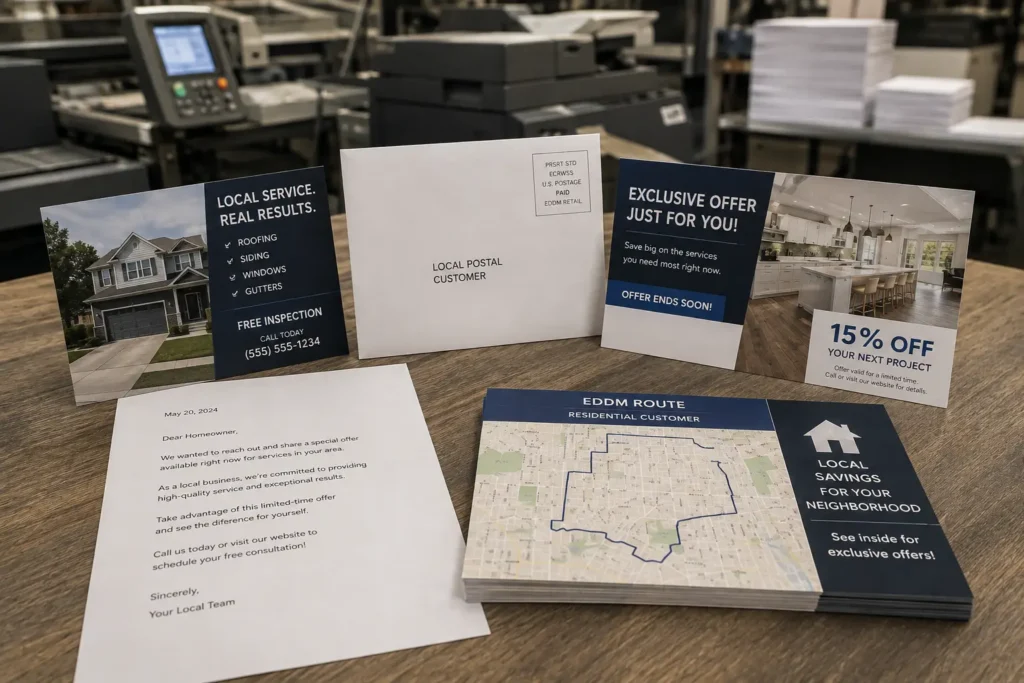
Every Door Direct Mail can reach every delivery address on selected postal routes without a purchased mailing list. It can fit restaurants, retail, home services, events, and neighborhood campaigns.
Variable Data Mail
Names, offers, images, locations, or other information can change by recipient when the data and production workflow support it. Every changing field should be tested before the full run.
Trackable Mail
A postcard, letter, or mailer can connect to a campaign landing page, phone number, offer code, custom URL, or QR code.
1st Class Marketing can coordinate graphic design and print production with mailing and tracking so the mail piece is planned as one campaign rather than several disconnected jobs.
Request pricing for your project and include the quantity, audience, format, and desired mailing date.
What Information Do You Need for a Direct Mail Quote?
A useful quote needs more than a quantity. Share what you know, mark what is still undecided, and ask the provider to identify anything that could change production or postage.
- Campaign goal: The response or business outcome you want.
- Quantity: The estimated number of pieces.
- Audience: Customer list, prospect criteria, ZIP codes, radius, or postal routes.
- Mail piece: Postcard, letter, self mailer, EDDM piece, or an undecided format.
- Finished size: Include folds, panels, envelopes, and inserts when known.
- Personalization: Names, variable offers, images, locations, or other changing information.
- Design status: New design, existing concept, or production ready artwork.
- Production details: Paper, color, coating, finishing, and proofing needs.
- Tracking: QR code, landing page, phone number, offer code, or another response method.
- Schedule: Desired mailing date or arrival window, plus any approval deadline.
Ask whether design, list work, printing, finishing, addressing, postal preparation, postage, delivery, and tracking are shown separately or combined. That makes competing quotes easier to compare.
Questions to Ask a Direct Mail Company Before Hiring It
The best questions reveal scope, ownership, and risk. They also help you compare providers that use similar marketing language but offer different workflows.
- Which campaign stages do you handle directly, and which are completed by outside partners?
- Can you help us choose between a targeted mailing list and EDDM?
- How do you clean, process, protect, and approve mailing data?
- Can your design team build the piece around the final postal and production requirements?
- What proof will we receive for artwork, personalization, quantities, and mailing details?
- What is included in the quoted price, and is postage shown separately?
- Who is our main contact, and who owns the campaign schedule?
- How do you handle a list change, file problem, production error, or missed approval?
- Which response tracking options can be planned before printing?
- Can you save specifications and reporting for repeat campaigns?
Clear answers are more important than impressive terminology. The provider should be able to explain the workflow in plain English.
Frequently Asked Questions
What does a direct mail company do?
A direct mail company may help with audience data, design, printing, personalization, address processing, postal preparation, mailing, and tracking. Services vary, so ask for a written list of what the provider and customer each own.
Is it cheaper to handle direct mail yourself?
It can be cheaper for a very small and simple mailing when your team already has the list, artwork, equipment, postal knowledge, and available time. Compare total cost, including staff time, supplies, rework, and vendor management, instead of comparing printing alone.
Can one company design, print, and mail postcards?
Yes. Some full service providers coordinate design, printing, addressing, postal preparation, and mailing. Confirm which work is completed in house, what is included, and who owns final approval.
Can a direct mail company provide the mailing list?
Many providers can build a targeted list, prepare an existing customer list, or help select EDDM routes. Ask which criteria are available, how records are sourced and maintained, and how the data may be used.
What is the difference between EDDM and targeted direct mail?
EDDM reaches every delivery address on selected postal routes and does not require a purchased address list. Targeted direct mail uses a defined list of recipients or households. EDDM favors geographic coverage. Targeted mail favors audience precision and personalization.
Can direct mail responses be tracked?
Yes. Common methods include campaign phone numbers, QR codes, landing pages, offer codes, dedicated URLs, and sales matchback. Choose the tracking plan that fits the action you are asking the recipient to take.
How much does a direct mail campaign cost?
Cost depends on quantity, format, paper, design, data, personalization, finishing, postal preparation, postage, tracking, and schedule. A detailed quote should show the assumptions behind the price.
Is postage included in direct mail pricing?
Sometimes. Some quotes include estimated postage, while others list it separately or require a postage deposit. Ask how postage is calculated, when it is due, and how the final amount is reconciled.
How far in advance should I plan a mailing?
Start as early as practical. Timing depends on list preparation, design, approvals, personalization, production, postal entry, mail class, and the desired arrival window. Tell the provider when the piece should reach recipients, not only when you hope to send the files.
Related Direct Mail Resources
Tell Us What You Are Planning to Mail
You do not need every specification before starting. Share the quantity, mail piece type, audience, design status, tracking needs, and desired mailing date. 1st Class Marketing can help organize the next decisions.
Real Data. Real Tracking. Real Results.
Mert Bayazitoglu
Creative Production Manager at 1st Class Marketing
Managing design, print production, and web at 1st Class Marketing with hands-on expertise in direct mail campaigns, graphic design, and digital execution for growth-focused businesses.