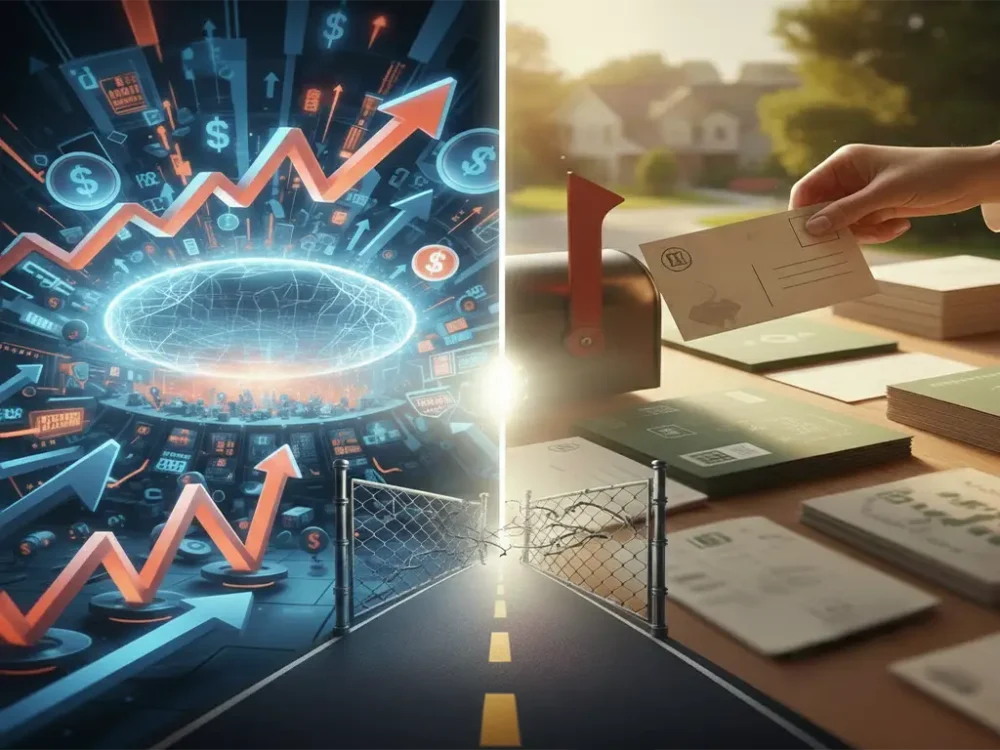
Direct mail is at the core of what we do. We design, target, and deliver campaigns that put your message in front of the right people and generate measurable results for your business.
Our in-house printing ensures quality and consistency on every project. From menus and brochures to business cards and door hangers, we create materials that make your brand look first class.
We transform data into strategy. By analyzing lists and customer segments, we uncover your best opportunities so every campaign is smarter, more targeted, and more effective.
We help your brand stay visible online with smart strategies that include email, social media, and online ads. These channels expand your reach and drive measurable business growth.
Smart marketing begins with strong data. At 1st Class Marketing, every campaign is guided by research and analysis to ensure your message reaches the right audience. Our data driven approach helps you reduce costs, boost response rates, and grow your business with confidence.
We believe powerful marketing begins with data. Every strategy is guided by research and analysis to reach the right audience with confidence. From direct mail campaigns to printing, design, and digital solutions, our team brings together creativity and strategy to make your business stand out. By combining data driven insights with eye catching campaigns, we help companies build stronger connections and achieve long term success.
From business cards to large scale marketing materials, we deliver printing that makes your brand stand out.
We specialize in direct mail campaigns that are targeted, cost effective, and proven to generate strong results.
“Best Marketing Company Ever!!! I have been working with Tiffany and Danielle for over five years now! Excellent Customer Service, Excellent Mail Campaigns, Excellent Response! My average closing is $9 million each month and growing.”
"It has been a pleasure doing business with you and hope to continue moving forward!"
"You guys are great! I just closed 8 loans off this campaign and can’t wait for the next one."
" 1st Class Marketing exceeded our expectations! Truly enjoy working with Danielle. Very professional and she makes it easy each and every campaign."
"I have used 1st Class Marketing for the last three years. Awesome company to work with and they will get your phones ringing."
"Thank you, thank you, and thank you!!! My company could not be more excited to have finally found an honest lead company. All of you are wonderful and I look forward to a successful year."
"Just wanted to say another good round of mailers, second batch has done really well, thanks!"
"Your Company has been a big part of our success over the last couple of years. I look forward to building on our relationship for years to come!!!!!!!!!!!!!!!!!!!"
"I just wanted to say thank you for all your help with my marketing and mailers. You guys have been great! I can tell that you are true professionals and I look forward to a long lasting business relationship."
From data to design, we focus on results that matter. Here’s what business owners and professionals say about their experience working with us.
Dynamic QR codes are the single biggest upgrade to direct mail marketing in the last decade. Let’s be honest, for years the biggest criticism of direct mail was the “attribution gap.” You knew your mailers were driving business because the phone would ring or foot traffic would spike, but unless the customer physically brought the coupon into the store, tracking the exact ROI felt like a guessing game. That is where the “Phygital” strategy comes in. It sounds like a buzzword, but Phygital (Physical + Digital) is just the necessary evolution of print. By integrating dynamic QR codes into your physical mail, you turn a static piece of paper into an interactive gateway. According to the 2025 State of Direct Mail Report by Lob, 82% of businesses increased their direct mail budgets specifically because of better integration with digital tools. Here is why dynamic QR codes are the secret weapon for modern campaigns and why you should never print a static code again. The “Oops” Insurance Imagine you print 10,000 postcards. They hit the mail stream, and suddenly you realize the landing page URL is broken, or your special offer has changed from 10% to 15%. With a standard static code, you are out of luck. That paper is already printed. But with dynamic QR codes, you remain in control. You can change the destination URL after the mail has been printed and delivered. You can update the landing page, switch the offer, or redirect traffic to a “Sold Out” page without ever changing the physical pixel pattern on the paper. It is flexibility that print has never had before, which is why dynamic codes captured 65% of the global market share in 2024. Analytics That Rival Digital Ads The old way of tracking mail involved asking, “How did you hear about us?” The new way involves hard data. When a prospect scans dynamic QR codes on your mailer, you don’t just get a site visit. Depending on your setup, you can track the exact scan time to know when your mail hits homes, the geographic location to see which neighborhoods are engaging, and even the device type. Knowing if your customers are on iPhone or Android helps you optimize your mobile experience instantly. This data is crucial because direct mail now boasts an average response rate of 2.7% to 4.4%, compared to email’s average of just 0.12%, according to the latest ANA Response Rate Report. The Retargeting Loop This is the most advanced play in the book. A user scans your mailer but doesn’t buy immediately. Because they visited your site via that specific digital gateway, you can tag them with a tracking pixel like a Meta Pixel or Google Tag. Now you can serve digital ads to the exact people who held your mailer in their hands. This multi-channel approach is proven to work. Response rates can jump to 27% when direct mail is paired with digital follow-up because you are reinforcing the physical message with a digital reminder. The Bottom Line Direct mail is powerful because it demands tactile attention. Digital marketing is powerful because it offers instant conversion. When you merge them using dynamic QR codes, you stop choosing between traditional and modern marketing and start getting the best of both worlds. What is the difference between a static and a dynamic QR code? A static QR code has a fixed URL embedded directly into the pattern; once printed, it cannot be changed. A dynamic QR code points to a redirect server first, allowing you to change the final destination URL anytime without reprinting the physical code. Can you track who scans a direct mail QR code? Yes. While you cannot identify the specific person by name without them filling out a form, dynamic QR codes allow you to track the number of scans, the time of the scan, the geographic location (city/state), and the device type used. How do QR codes help with retargeting ads? When a user scans a dynamic QR code, they land on your website where a tracking pixel (such as Meta Pixel or Google Tag) can be triggered. This allows you to serve digital ads specifically to the people who engaged with your physical mail piece.
Read More
The Tangible Standard: Why Modern Brands Demand Physical Print We live in an economy of pixels. A customer in California can order from a business in New York with a single click. Information moves at the speed of light. But in this rush of digital noise, the human brain still craves something solid. That is why commercial printing services remain the backbone of successful national marketing campaigns. At 1st Class Marketing, we provide commercial grade solutions for businesses across the entire United States. We understand that while digital marketing captures attention, physical print captures the imagination. We do not just put ink on paper. We engineer physical assets that build authority, deepen comprehension, and establish trust for your brand nationwide. The Neuroscience of Ownership Why do you value a physical book more than a digital file? It is not just nostalgia. It is biology. Research into the neuroscience of touch reveals that physical media leaves a deeper footprint in the brain than digital media. The United States Postal Service Office of Inspector General partnered with Temple University to study this phenomenon. They found that physical ads trigger activity in the ventral striatum. This is the part of the brain responsible for value and desirability. When a customer holds your brochure or catalog, their brain begins to feel a subconscious sense of ownership. This “Endowment Effect” makes it harder for them to discard the information. Digital ads do not trigger this same response. You can read the full report on this neurological research here: USPS OIG: Enhancing the Value of Mail The Science of Deep Reading We read differently on screens. When we look at a monitor or phone, we tend to skim. We hunt for keywords rather than absorbing the full message. Paper encourages “deep reading.” This is a state of focused attention where the reader fully comprehends complex information. If you are selling a complicated product or a high value service, you need your customer to focus. According to research cited by Oxford Learning, students and adults consistently show higher comprehension scores when reading on paper versus screens. The physical cues of the page help the brain map out the information. By using professional commercial printing services to produce your detailed sales materials, you are actually helping your customer understand your value proposition better. Review the findings on reading comprehension here: Oxford Learning: Screen vs. Paper Reading Sustainability and Responsibility A common myth is that digital is always greener. The truth is more nuanced. The paper industry is one of the few industries that plants more than it harvests. Paper is a renewable resource. According to the American Forest & Paper Association (AF&PA), paper recycling rates in the United States have remained consistently high, often exceeding 60 percent. The industry is a leader in sustainable forestry and recycling infrastructure. When you print on sustainable stock, you are using a material that is circular by design. We offer a wide range of recycled and certified paper options to ensure your marketing aligns with your environmental goals. See the latest data on paper recycling rates here: American Forest & Paper Association: Sustainability Facts Why Commercial Printing Services Build Trust The internet is crowded with unverified information. Phishing emails and fake websites have made consumers skeptical. Physical print implies legitimacy. Scammers rarely spend the capital to print thousands of high quality brochures or catalogs. Consumers know this instinctively. When you invest in physical materials, you signal that you are a real, established, and trustworthy entity. The Federal Trade Commission (FTC) frequently warns consumers about online fraud. By placing a physical document in your customer’s hands, you bypass the anxiety associated with clicking unknown links. View consumer protection resources here: Federal Trade Commission: Consumer Information Our Nationwide Capabilities We are equipped to handle massive volume without sacrificing the fine details that define premium quality. Here is how our commercial printing services help businesses across the country elevate their image. 1. Advanced Color Precision Your brand colors are your identity. Your corporate red or blue must look exactly the same on a business card as it does on a large presentation folder. We use advanced color management systems to monitor ink density and color balance. This guarantees that your marketing collateral looks identical in every state where you do business. 2. Diverse Paper Stocks and Textures We offer a vast library of paper options to suit any project. Heavy Cover Stock: This provides rigidity and durability. It conveys strength. Gloss and Matte Finishes: We guide you on when to use gloss for popping colors or matte for a sophisticated look. Specialty Textures: We can source unique papers that engage the fingertips and make people pause. 3. Professional Bindery Services The printing is only half the job. The finishing is what turns a stack of paper into a product. Saddle Stitching: We use this for magazines, newsletters, and program guides. Perfect Binding: This creates a flat and square spine for a polished appearance. It is ideal for thick catalogs. Precision Folding: We handle everything from standard letter folds to complex architectural folds for maps. Nationwide Consistency You do not need a printer in every city. You need one partner who can handle it all. At 1st Class Marketing, we combine the capacity of a national manufacturer with the care of a craftsman. We are big enough to handle your largest campaign but focused enough to catch the smallest detail. Whether you are a franchise chain needing uniformity or a corporation launching a new product line, our commercial printing services ensure your assets are perfect every time. Let us handle the production. You handle the growth.
Read More
If you are looking for honest Direct Mail Marketing FAQs in 2026, you are in the right place. The digital inboxes of your customers are noisier than ever, and you might wonder if sending physical letters or postcards still makes sense. The short answer is yes. The long answer is backed by hard data. We have compiled the most critical Direct Mail Marketing FAQs and answered them using the latest industry facts from late 2025 and early 2026 reports. No guesswork. Just the numbers you need to make informed decisions. Top Direct Mail Marketing FAQs: Is it still effective? One of the most common Direct Mail Marketing FAQs we hear is simply: Does it still work? Direct mail is not just effective; it is currently outperforming many digital channels in engagement. The Return on Investment (ROI) for direct mail remains a standout metric. Industry reports from late 2025 indicate that direct mail campaigns can generate an ROI of up to 161%. This performance is driven by “digital fatigue.” With the average person receiving hundreds of emails daily, a physical letter stands out because it is tangible. It occupies real physical space in a home, which leads to our next point about lifespan. How long does a piece of direct mail last compared to email? One of the most compelling statistics in our industry concerns the “lifespan” of a marketing piece. Email Lifespan: Approximately 17 seconds. Direct Mail Lifespan: Approximately 17 days. According to data referenced by leading marketing authorities like Lob and PostGrid, a physical mail piece stays in the home for over two weeks on average. It gets placed on counters, stuck to refrigerators, and shared among household members. This extended shelf life creates multiple opportunities for a brand impression. An email is usually deleted or archived within seconds of being opened. What are the open rates for direct mail vs email? Visibility is the first hurdle in any marketing campaign. If they do not see it, they cannot buy it. Direct Mail Open Rate: Up to 90%. Email Open Rate: Typically 20% to 30%. Almost everyone checks their physical mailbox. Even if a recipient sorts their mail over the recycling bin, they are still touching, scanning, and making a conscious decision about your brand. That specific moment of physical interaction is guaranteed engagement that email simply cannot provide. What is the average response rate for direct mail? Getting a prospect to open the mail is good. Getting them to act is better. The Association of National Advertisers (ANA) and recent 2025 benchmarks place the average response rate for direct mail around 4.4% for prospect lists. When targeting a house list (people who have already bought from you), that rate can jump significantly higher, often reaching 9%. Compare this to digital channels: Direct Mail Response: ~4.4% Email Response: ~0.12% You would need to send exponentially more emails to get the same number of responses you would get from a targeted direct mail campaign. Does direct mail work for younger generations? There is a common misconception that direct mail only works for older demographics. The data suggests the opposite. Younger generations are actually more responsive to mail because it feels novel and trustworthy to them. USPS research has found that 82% of Millennials view print advertisements as more trustworthy than digital ads. Furthermore, 74% of Gen Z consumers prefer physical experiences over digital ones. Because Millennials and Gen Z are digital natives, they are the most skilled at filtering out digital noise. A physical postcard bypasses those digital filters completely. How can I track the results of a direct mail campaign? Direct mail is no longer a “spray and pray” tactic. It is a data focused channel that tracks just as accurately as digital ads. Modern campaigns use several methods to attribute success: QR Codes: Usage is rising. When a customer scans the code, you know exactly who they are and which mail piece convinced them to act. Personalized URLs: You can assign a unique web link to each recipient (e.g., yourwebsite.com/JaneDoe). This offers 100% accurate tracking of who visited your site. Matchback Analysis: This is the gold standard of attribution. After a campaign, you compare your list of mailed records against your list of sales. If Jane Doe got a postcard on Tuesday and bought a product on Thursday, matchback analysis credits that sale to the mail piece. Does combining direct mail with digital marketing help? Absolutely. Direct mail works best when it is part of an omnichannel strategy. Integrating direct mail with digital tactics (like following up a postcard with an email) can boost response rates by 63% or more. Marketers who use this “surround sound” approach report higher website visits and conversion rates. The physical mail piece primes the customer, making them more likely to click when they subsequently see your digital ad or email. Ready to Boost Your ROI? The facts are clear: Direct mail delivers higher open rates, stronger trust, and better response rates than almost any other channel in 2026. If you are ready to get your brand into the hands of your customers, we can help you build a strategy that works. Contact us today to start your campaign Sources for further reading: USPS Delivers: The Future of Direct Mail Lob: State of Direct Mail Reports ANA: Response Rate Reports
Read More